Why she matters
A more humble view of the human animal
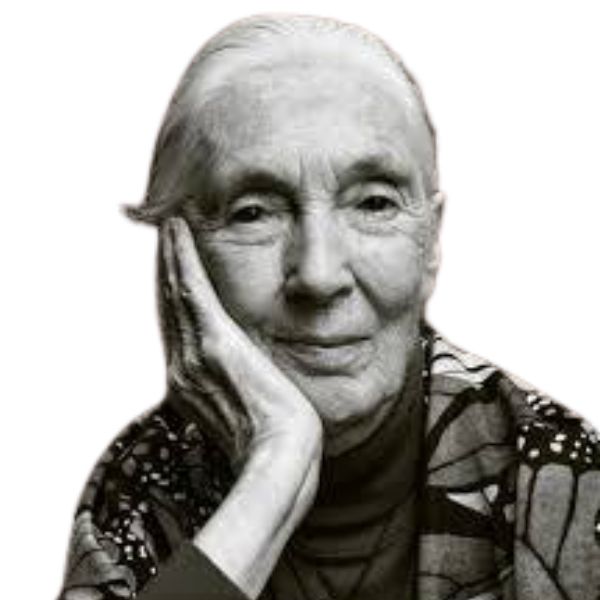
Jane Goodall matters because her work helped unsettle one of humanity’s deepest assumptions: that we stand radically apart from the rest of life. Her observations of wild chimpanzees at Gombe showed intelligence, emotion, social complexity, tool use, violence, tenderness, personality, and continuity with our own species.
For ALU, Goodall is important not only as a scientist, but as a moral witness. Her work moves from patient observation to responsibility. If animals are not mere objects, and if humans are not outside nature, then our treatment of the living world becomes part of the story of who we are.
Core ideas
Ideas worth returning to
Humans are part of nature
Goodall’s work reminds us that human beings are not detached observers standing outside the living world. We are continuous with it, dependent on it, and responsible within it.
Animal minds deserve seriousness
Her close attention to chimpanzees challenged simplistic views of animals as instinctive machines, opening space for emotion, personality, memory, relationship, and culture.
Observation requires humility
Goodall’s method was rooted in patience, attentiveness, and respect for what the subject reveals over time. That is a scientific virtue, but also a human one.
Hope is not denial
Her public message of hope is not sentimental optimism. It is a call to act, even when the environmental situation is grave and the future is uncertain.
Conservation must include people
Goodall’s conservation work recognises that protecting animals and ecosystems cannot be separated from the needs, dignity, and participation of human communities.
Kinship enlarges ethics
Seeing ourselves as kin to other living beings does not diminish humanity. It can deepen our ethics by widening the circle of concern.
Key works
Where to begin
In the Shadow of Man
Goodall’s classic account of her early years studying wild chimpanzees at Gombe and the discoveries that changed primatology.
Reason for Hope
A reflective work that connects her scientific life with moral responsibility, conservation, resilience, and the question of hope.
The Book of Hope
A later conversation-centred work focused on why hope still matters in an age of ecological anxiety and cultural exhaustion.
Connection to ALU
What Goodall helps us untangle
A Life Untangled is interested in the human condition, but Goodall reminds us that the human condition cannot be understood by looking at humans alone. We are primates, social animals, ecological beings, cultural storytellers, and moral agents embedded in a living world.
Her work helps untangle the tension between intelligence and responsibility. We are powerful enough to damage the planet, but conscious enough to know what we are doing. That makes Goodall’s message both scientific and ethical: seeing clearly should lead to care.
She also offers a counterweight to despair. Hope, in her sense, is not a mood. It is a discipline of attention and action — a refusal to let the scale of the problem excuse inaction.
Related from the archive
Follow the thread
Questions raised
Questions Goodall leaves us with
- What changes ethically when we see animals as individuals rather than objects?
- Can science remain rigorous while taking empathy seriously?
- What does our kinship with other primates reveal about human nature?
- Is hope a feeling, a responsibility, or a form of disciplined action?
- Can conservation succeed if it ignores the lives and needs of local human communities?
Further reading


